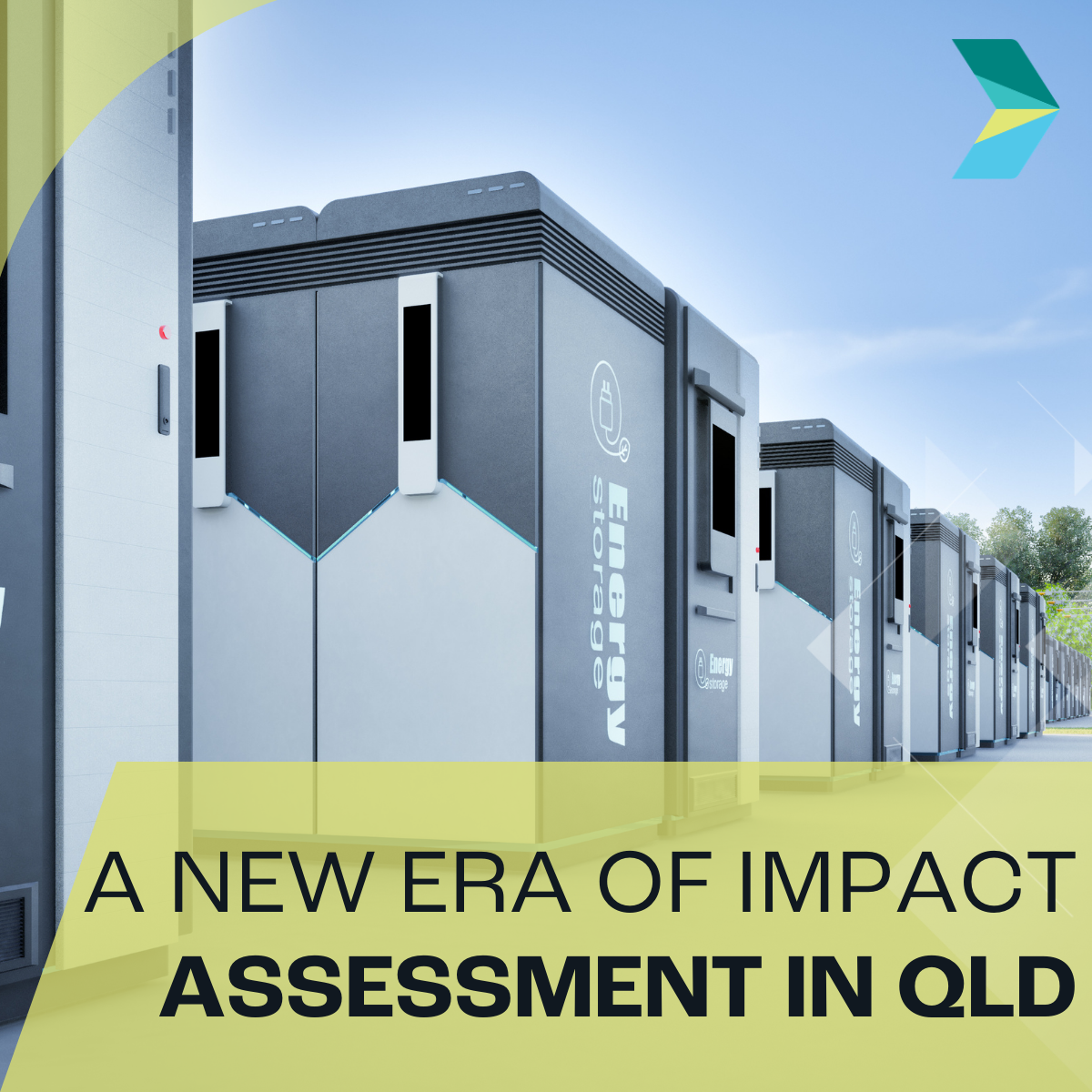
The new era of impact assessment in QLD
QLD’s renewable energy landscape is changing and battery storage has also now entered a new phase of regulatory scrutiny.
In December 2025, the QLD government introduced significant planning reforms that bring large-scale BESS projects into the same assessment framework already applied to wind and solar farms.
These reforms follow on from earlier changes in 2025 that made solar and wind developments impact assessable and required developers to complete social impact assessments (SIAs) and community benefit agreements (CBAs) before applications could proceed.
What has changed for BESS projects?
Until late 2025, stand-alone battery storage facilities were typically governed by local planning schemes, meaning each local council applied its own rules. This patchwork resulted in uncertainty and inconsistency for developers and communities alike.
But from 12 December 2025, under the Planning (Battery Storage Facilities) and Other Legislation Amendment Regulation 2025:
large-scale BESS (50 MW or more) are now impact assessable, aligning them with the planning treatment previously applied to solar and wind
these projects must undertake a SIA and negotiate a CBA with local government before submitting a development application
assessment responsibility has shifted from councils to the State Assessment and Referral Agency (SARA), meaning applications are evaluated under a consistent state framework
a new State Code 27: Battery Storage Facilities sets clear benchmarks for issues like safety, bushfire risk, noise, and agricultural impacts
Smaller battery facilities (those under 50 MW) continue to be dealt with under local planning schemes and are generally accepted development if they meet certain criteria.
Why these reforms matter
These changes mark a significant shift in how QLD manages battery storage as part of its energy transition.
By treating BESS projects like solar and wind farms, the QLD government has created a unified planning pathway that reduces fragmented decision-making and gives communities predictable standards for assessment.
SIAs and CBAs aim to ensure local communities are consulted and that projects deliver tangible benefits, not just energy infrastructure. This approach is meant to enhance transparency and community confidence.
With SARA managing assessments, and State Code 27 providing clear criteria, proponents and stakeholders can better understand what’s expected in terms of environmental, social, and safety outcomes.
What this means for the future
QLD’s battery storage market is at a pivotal moment. With the state rapidly expanding its renewable and storage fleet to balance a decarbonising grid, these planning reforms may shape where and how BESS projects are delivered for years to come.
For developers, the message is clear: community engagement, social impact planning, and benefit sharing aren’t just optional extras. They are now central to project success.