
Renewable project approvals under pressure
Australia needs to deliver renewable energy infrastructure at significant scale and pace. But for the people responsible for getting projects from concept to construction, the approvals pathway is becoming increasingly challenging.
The Clean Energy Council and Lockton’s inaugural ‘Renewable Energy Risk and Insurance Index 2026’ released this week provides a clear snapshot of where industry is feeling that pressure.
Of the 146 survey respondents, 81% rated state-based development and environmental approvals as difficult or very difficult, making it the most challenging of the eight areas assessed. Commonwealth environmental approvals were rated difficult or very difficult by 66%.
The trend is also moving in the wrong direction. Seventy-one per cent said state-based development and environmental approvals had become harder over the previous three years, while only 5% said they had become easier.
Community engagement and support ranked second, with 66% saying it had become harder, ahead of grid connection and registration at 56% and supply chain and procurement at 50%.
These findings reflect a broader challenge for proponents. Renewable energy projects can require extensive technical investigations, environmental assessment, agency consultation, community engagement and ongoing design refinement before a determination is made.
Longer and more complex approval processes can increase costs, create uncertainty and extend engagement programs over several years. The report also identifies consultation fatigue, particularly in areas experiencing multiple renewable energy and transmission projects.
The prominence of community engagement in the survey is particularly telling. While 58% of respondents currently rate community engagement and support as difficult or very difficult, two-thirds believe it has become harder in only three years.
Engagement is increasingly starting earlier and continuing throughout planning and assessment, rather than being concentrated around statutory consultation periods. For proponents, this means maintaining trust and communication while project information, designs and timelines continue to evolve.
The challenge is not simply to make approvals faster.
The Clean Energy Council calls for approval systems that are clearer, better coordinated, risk-based and proportionate, while maintaining strong environmental outcomes. Priorities include reducing duplication, improving agency resourcing and providing more consistent assessment processes and timeframes.
For proponents, the same principle applies. Early identification of environmental and social risks, integrated technical and engagement programs and strong coordination between project teams can help reduce issues emerging late in the assessment process.
The approvals pathway itself has become a significant project delivery risk.
Managing that risk requires environmental assessment, planning, engagement and project design to work together from the earliest stages of development.
Ask us how we can help.
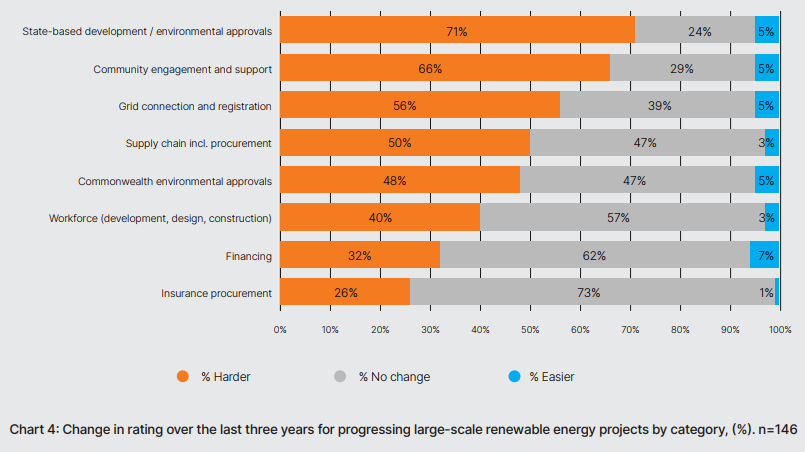
71% of survey respondents said state-based approvals have become harder over the past 3 years
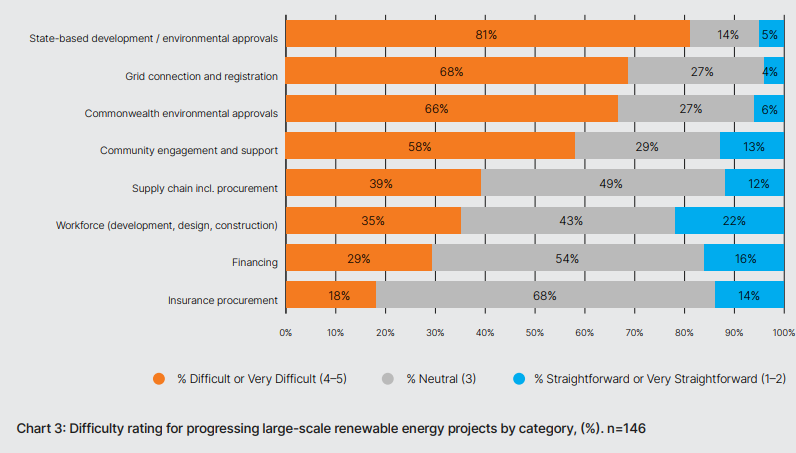
81% of survey respondents rated state-based approvals as difficult or very difficult