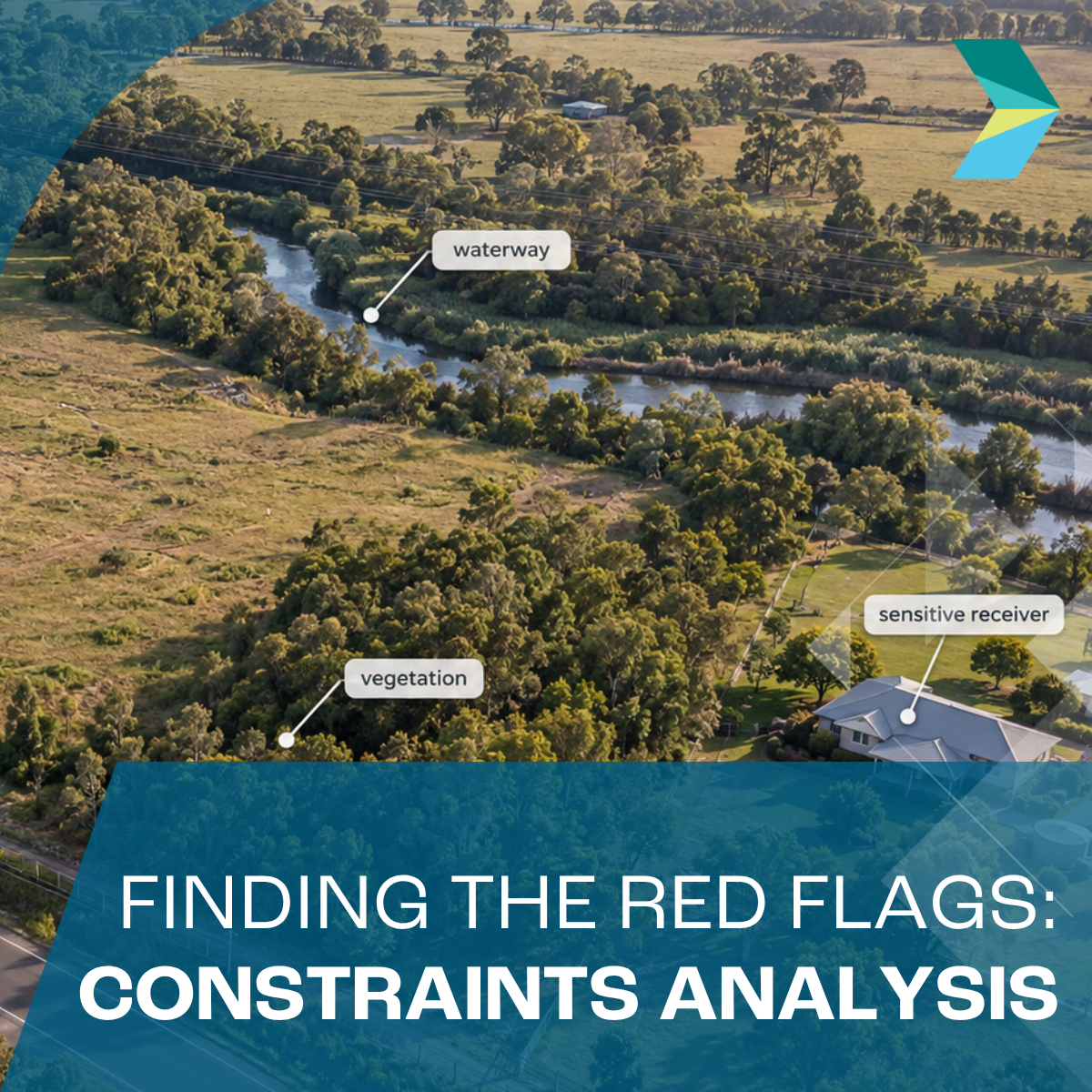
Finding the red flags early
For a major development project, some of the most valuable work can happen before the formal planning process begins.
A preliminary constraints analysis can help proponents understand the environmental, planning, social and physical characteristics of a site before significant time and resources are committed to a project concept.
For a proposed state significant development (SSD) in NSW, this early work can provide an important foundation for the scoping phase. It can identify potential red flags, highlight areas requiring further investigation and, importantly, provide an opportunity to respond to constraints while there is still flexibility in project design.
What is a constraints analysis?
A constraints analysis is an early, multidisciplinary review of a proposed development site and its surrounding context.
Depending on the project, it may consider:
land zoning and permissibility
biodiversity and ecological sensitivity
Aboriginal and historic heritage
waterways, flooding and bushfire risk
topography, soils and geology
road access and transport constraints
nearby sensitive receivers
noise and visual considerations
existing infrastructure, utilities and easements
land tenure and property boundaries
nearby proposed or approved developments
cumulative impacts
surrounding communities and social infrastructure
The purpose is not to complete the environmental impact assessment early. It is to identify the issues that may influence project design, approvals, technical investigations, timing or cost.
Why do it before SSD scoping?
The scoping phase is intended to identify the matters that need to be investigated through the environmental impact statement (EIS).
NSW Government guidance expects a scoping report to address matters including site selection, project alternatives, strategies to avoid or minimise impacts and the key issues requiring further assessment.
A constraints analysis undertaken beforehand gives the project team a stronger basis for making those decisions.
Instead of beginning with a fixed site layout and then identifying problems around it, the project can be shaped with an understanding of the site's constraints from the outset.
That can improve both the project itself and the assessment process that follows.
Identify project risks while there is still room to respond
Not every constraint is a fatal flaw. A biodiversity value, sensitive receiver, heritage item, flood-prone area or constrained local road network may be manageable through design, avoidance, mitigation or further assessment.
The important thing is knowing about it early.
For example, if the preferred development footprint intersects an environmentally sensitive area, there may be an opportunity to reposition infrastructure before detailed design progresses.
Similarly, if access relies on a road network with known capacity or safety constraints, alternative routes or construction approaches can be considered before traffic studies and engagement are built around an unsuitable option.
Changes that are relatively simple at concept stage can become significantly more complicated later.
Support better project design
One of the greatest benefits of early constraints analysis is the opportunity for avoidance.
Environmental assessment is sometimes viewed as the process of assessing the impacts of a project design that has already been developed. In practice, some of the best impact management happens earlier.
Understanding constraints before a design is fixed can help determine where infrastructure should be located, which areas should be avoided and where further investigation is needed.
This allows environmental and social considerations to help shape the project, rather than simply being assessed after the design is largely settled.
Strengthen scoping and technical investigations
Early constraints work can also lead to a stronger scoping report.
It gives the project team a clearer basis for explaining:
why a site or development area has been selected
what alternatives have been considered
how impacts have already been avoided or reduced
where uncertainty remains
which matters require detailed EIS assessment
It can also help technical specialists focus their investigations more effectively.
The result is not necessarily fewer studies, but better targeted studies informed by a clearer understanding of project risk.
Look beyond the project boundary
A good constraints analysis should also consider what is happening around the site.
Nearby developments may place cumulative pressure on roads, housing, services, workforce availability or community infrastructure.
Understanding these issues early can influence traffic assessment, workforce planning, social impact assessment, construction scheduling and community engagement.
It also helps identify who may actually be affected by the project. That may extend beyond people living closest to the site, particularly where impacts follow transport routes, viewsheds, workforce movements or shared infrastructure.
Better-informed engagement
Early constraints work can also improve conversations with communities and stakeholders.
Desktop analysis cannot replace local knowledge, but project teams should understand the obvious characteristics of a site before asking communities to identify them.
Entering engagement with a sound understanding of the local context allows discussions to focus on testing assumptions, identifying gaps and understanding issues that may not be visible through technical data alone.
That can lead to more informed and credible engagement from the outset.
Finding issues early creates options
There will always be new information as a project progresses.
Technical studies reveal more detail, designs change and engagement provides knowledge that desktop analysis cannot.
Constraints analysis will not remove that uncertainty.
What it can do is reduce the likelihood of foreseeable issues emerging after substantial time and resources have already been committed.
For proponents considering a SSD, the formal scoping process does not need to be the starting point for understanding the site.
A well-designed constraints analysis can identify risks early, improve project design, focus technical assessment and support more informed engagement.
Finding a constraint early does not necessarily mean finding a problem. Often, it means finding the opportunity to make a better project.